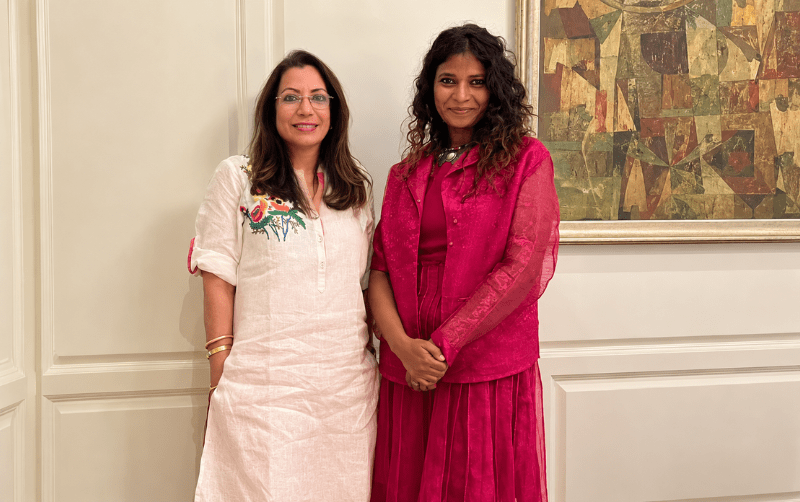

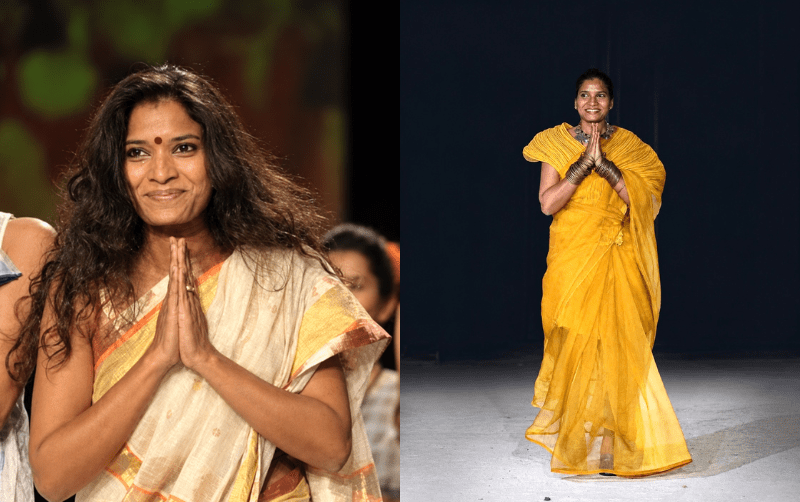
From Vidisha, Madhya Pradesh, to Paris, Vaishali Shadangule has travelled far. But somewhere between the looms of India’s villages and the couture salons of Paris, she has discovered something more powerful than fashion- her own language. Her language is handloom and texture enriched by Mother Nature. It is the imperfect beauty of something made by hand. And increasingly, it is about taking what India has always had- its weaves, its crafts, its extraordinary artisan traditions and making the world look at them differently. Where does her story really start? Born in Vidisha, Madhya Pradesh, she left her hometown as a teenager (17). Eventually, she found her way to Bhopal and later Mumbai, where she worked, learnt, observed, and taught herself. Knowing a formal fashion education was beyond her means, she somehow got the SNDT College syllabus and studied it herself.
Her first store, she recalled, was a tiny100-square-foot space in Malad, which she started with a bank loan of just ₹50,000.‘But I didn’t come from a conventional fashion background. There was no obvious road map telling me how to become a designer. So I had to find my own way,” she shared, and perhaps that is why she’s still very comfortable experimenting today. She learnt by observing, asking questions, looking at fabric, and making mistakes.
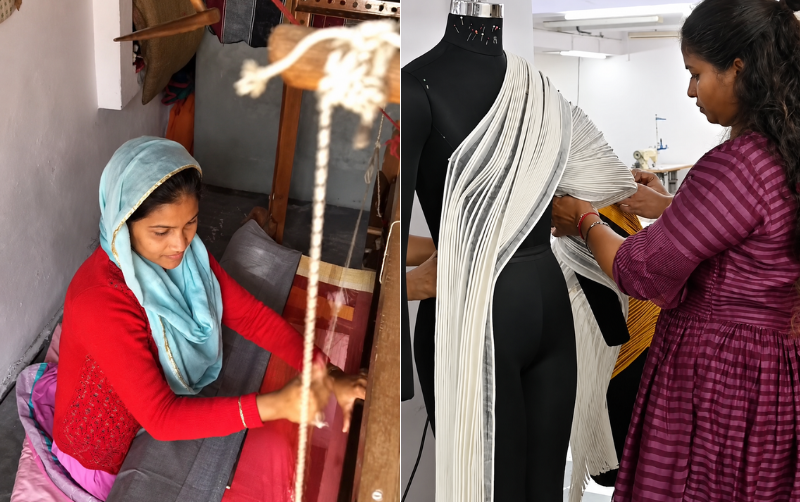
You didn’t have the luxury of a conventional fashion education. Did that become a disadvantage or an advantage? She replied-‘ In the beginning, it was certainly a limitation. But limitations can also make you resourceful. I found other ways of learning. I studied what I could, sought out information and eventually trained myself through experience. I think design education can teach you many things. But curiosity teaches you how to keep looking. And that looking seems to have taken you into India’s villages.-‘ I have always been fascinated by what exists outside the obvious. Some of my strongest inspirations have come from travelling through villages and discovering textiles and techniques that are disappearing or are barely known outside the communities that make them. I don’t go looking for something fashionable. I go looking for something authentic. And when you meet the people who have been weaving for generations, you realise that the textile is only one part of the story. There is an entire culture behind it-she added.
Is that why handloom became almost a philosophy for you rather than simply a material? Absolutely. A handwoven textile has a personality; it has irregularities, texture and the human hand in it. I did not want to erase those qualities. I wanted to bring them forward. That is also why my design process often begins with the textile rather than with a finished garment in my mind. You have spoken about forgotten weaves. What draws you towards the lesser-known rather than the already celebrated? Because we’ve stopped seeing so much beauty. India has an extraordinary vocabulary of textiles. Some are famous; others are known only within a particular region or community. When you discover them, you realise that they don’t need to be “improved. They need to be understood. My role is to find a contemporary way to let that textile speak.
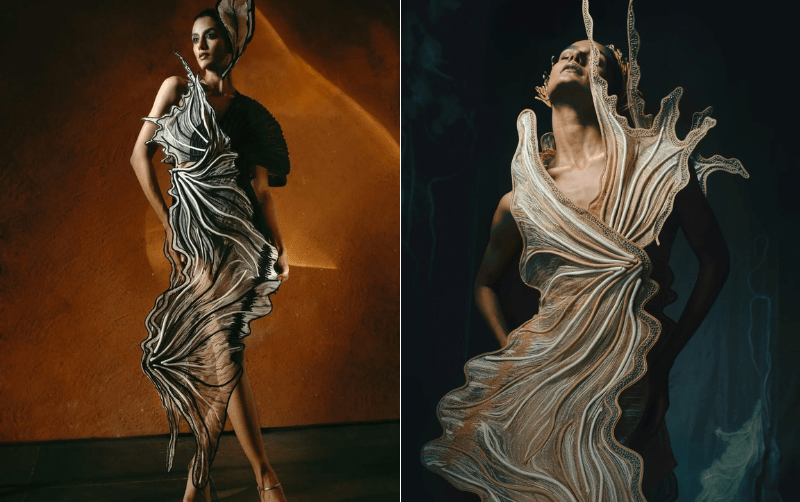
Your clothes don’t look like traditional handloom in the conventional sense, but they can be extraordinarily sculptural? She smiled and added, ‘That comes from wanting to push the boundaries of what handloom can do. I am interested in taking a flat piece of fabric and giving it volume, movement and structure. My cording technique has become part of my signature because it allows me to create almost three-dimensional forms from the textile. But the fabric must still remain itself.‘
Swayam, her latest Paris presentation seems almost like a continuation of her own journey. It brought 30 handwoven couture creations to the international stage, drawing on 14 Indian weaving traditions and the work of an artisan network spanning more than 4,500 weaving families across seven states. As usual, my curiosity led me to know the woman behind all those numbers. She speaks about Swayam: I imagined a flower blooming in an empty field. It doesn’t wait for someone to notice it. It doesn’t need an audience. It simply blooms. That became a metaphor for the woman I wanted to dress, a woman who has reached a point where she doesn’t need external approval to know who she is. And then she put that woman on a Paris runway- barefoot. That element was very deliberate. Since every flower begins with a root. She wanted that connection with the earth to remain. The collection moved from Beej, the seed, towards Mukti, the full bloom, with Swayamprabha -the woman who shines in her own light-at its centre. There was something wonderfully Indian about that idea, yet the presentation is unmistakably international.
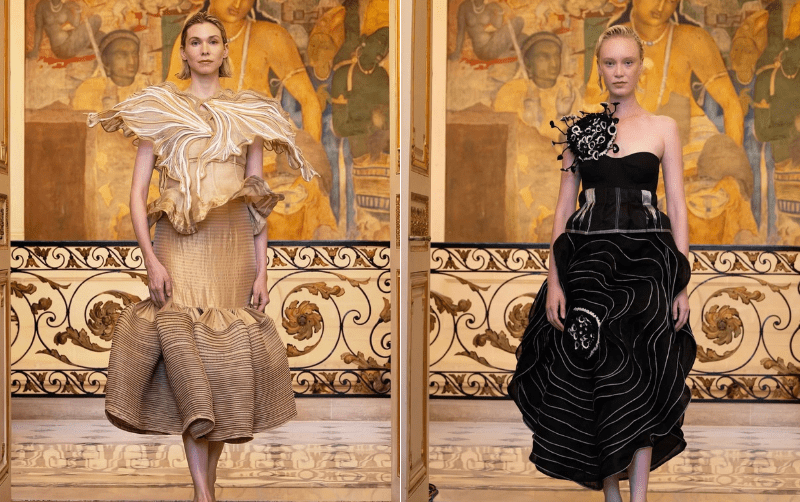
Being recognised as a couturier comes with a certain responsibility. It means that the quality of your work, your processes and your creativity have to meet a very high standard. ‘But I don’t want Paris to determine who I am as a designer. My roots are still in India. Handcraft is very important. luxury today should make us appreciate time rather than escape it.‘ Vaishali also makes sure she uses leftover fabrics in her work. That comes from the values she grew up with. ‘In village life, one does not simply throw something away because you have finished using it.‘ She finds use for scraps and leftover textiles as embellishment and in other creative applications.
There is an entrepreneurial story here too. Did she ever imagine that from a very small beginning to an actual Paris flagship, that she would have an international couture presence some day?’ ‘Strangely, I was always focused on the work rather than the destination. I didn’t start with a grand plan to become an international designer. I started because I wanted to create. The business grew because the work grew. And every stage brought a different lesson’.
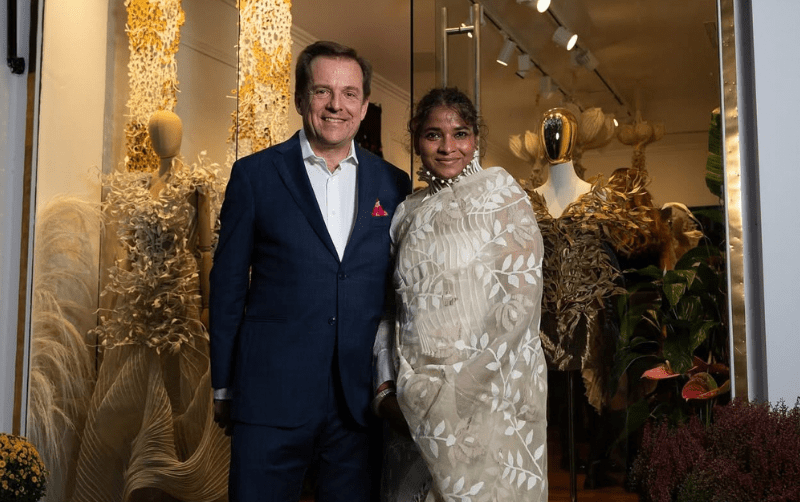
What if we stripped away Paris, couture, the stores, the awards, and the applause, who is Vaishali then? ‘I think I am still the same person who wants to observe, learn and create. Only the circumstances have changed. The curiosity has remained. And perhaps that is what keeps me moving’What stayed with me after looking at Vaishali’s journey was that- Paris isn’t really the story. Paris is merely her stage. The real story is what she carried there. The forgotten weaves, the villages, the hands of thousands of artisans. The imperfections that machines cannot reproduce. The belief that something made slowly can still have a place in a world obsessed with speed. And perhaps most importantly, the idea behind Swayam. A flower doesn’t bloom because someone is watching. It blooms because it is ready. And maybe that is Vaishali’s story too. She simply kept creating, kept travelling, kept learning, kept looking – until one day the world began looking back. That, to her, is the real luxury. Not being seen. But becoming herself completely!