

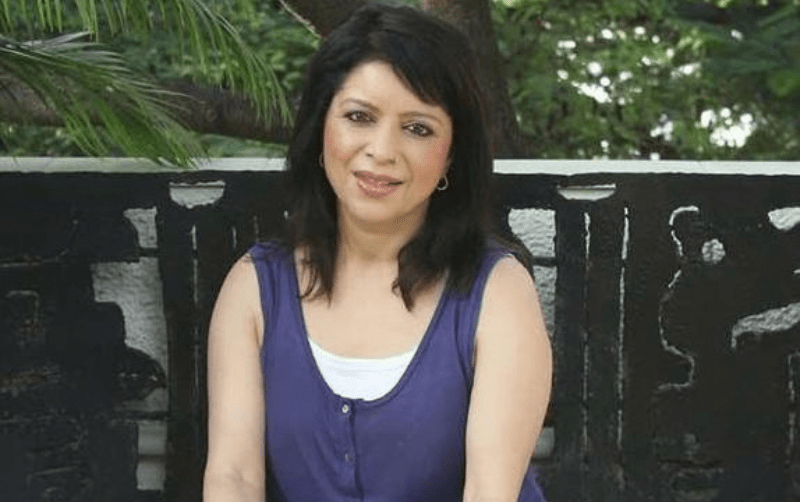
Artists whose work one recognises immediately have spent a lifetime perfecting one particular visual language. Then there are artists like Madhuri Bhaduri. She is a Pune-based artist who has spent more than four decades painting, experimenting, changing direction and, perhaps most importantly, allowing life to find its way into her art. I perceived her journey as moving from impressionistic light and colour to landscapes, cityscapes, seascapes, and nature, then on to abstraction, sculpture, assemblage, and found objects. But art wasn’t always her obvious destination.
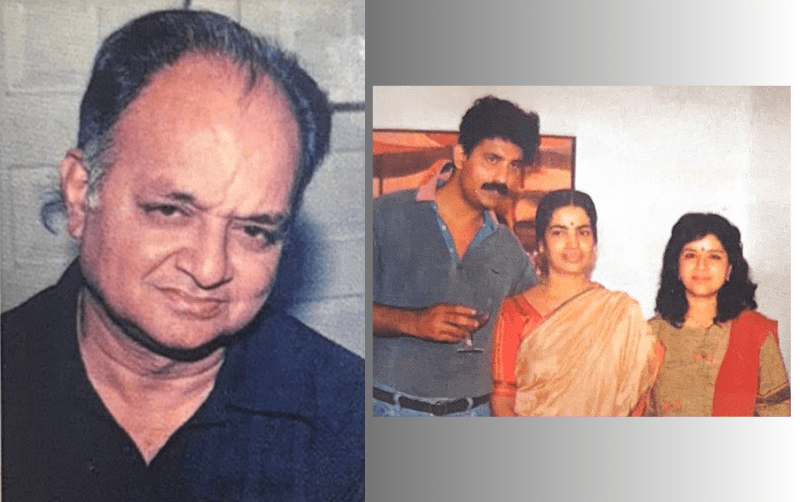
Born in Pune (1958), she came from what she describes as a cultured family, including her mother, Durga Phalnikar (a classical Maharashtrian, A-grade singer for 5 decades), and father, ?Phalnikar ( a national-level badminton player). Madhuri took that sporting gene seriously, becoming a national-level badminton player, and later she even played squash at the national level. There is something wonderfully contradictory about the image of a competitive sportsperson eventually disappearing into the solitude of a studio. The badminton court demands speed, discipline, and instinct, and the canvas demands patience. Young Madhuri had mastered both. Her early education was also far from being exclusively artistic. An Economics student at Fergusson College in Pune, she also studied French at Alliance Française. She received her formal training in painting at SNDT University in Mumbai, where she completed her Master’s in Art and Painting. But by that time, the artist in her had already begun to emerge.
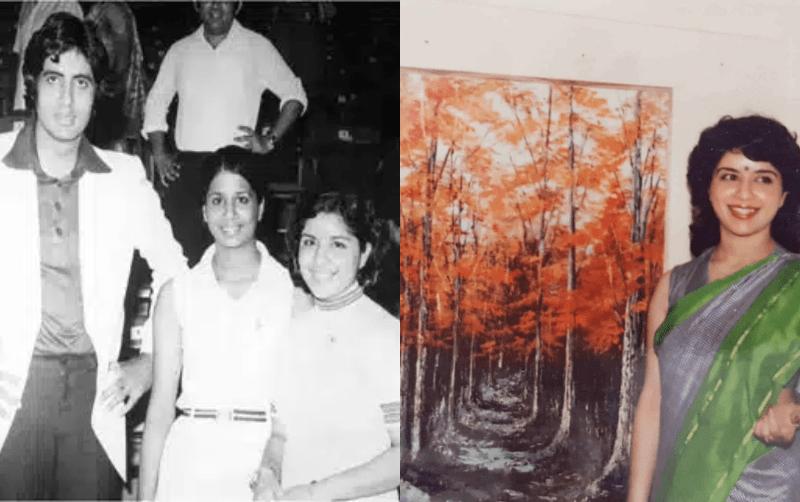
Her love for the arts led her to painting as early as 1977, resulting in her first solo exhibition in Pune (1986) and marking the beginning of what would become a long and remarkably varied professional journey. Madhuri’s early work drew on Impressionism; she was fascinated by light, colour, and the mood of a moment, not merely by reproducing what she saw. That distinction proved important. Clearly, because even in those early years, she wasn’t simply painting objects. She was painting how something made her feel. She comes from a generation where artists painted because they wanted to paint.
All that obviously came from her multi-layered life where she dealt with much grief. From working at a small advertising agency (2 years) before her marriage to her husband (Shekar), who went through a 12-year-long illness (Crohn’s disease), resulting in multi-organ failure and his passing away (2007). Totally helpless and alone, she took to her art even though her son was by her side. She also lost her dad at 29, even before she married at 30. A spiritual type of person, Madhuri has always felt she was the Universe’s chosen one, and she says that-‘Nobody has ever promoted me; my buyers are the biggest promoters in my entire journey” One can almost see a philosophical thread running through her work.
WHEN LANDSCAPES BECAME MEMORIES
During the 1990s, her work moved towards landscapes and cityscapes, while she continued to explore abstraction. Trees, foliage, fields, water, seascapes and other elements of nature began appearing in her work. But these were never meant as simple photographic reproductions of scenery. The memories came from places she had visited, roads she had travelled, and things she had seen and carried back with her. Her own description of this period is revealing: ‘The paintings were about bringing home a vignette of natural beauty rather than conveying a social message. They were less about geography and more about remembrance’. Indeed, it is special when an artist can travel somewhere, return home and realise that what she brought back wasn’t a souvenir but an image living somewhere inside her.
But she soon broke free, and around the turn of the millennium, Madhuri’s art began to don a few new faces all over again. From 2001 onwards, she experimented with assemblages, sculptures and murals, using scrap metal, found objects, fibre glass and other materials. It seemed like she was leaving one terminal for another. But perhaps departure is the wrong word when talking about Madhuri. She seems to have spent her artistic life moving toward greater freedom. The canvas became less restrictive, and abstraction became increasingly important. Her art began to speak her mind again; it began looking inward. For Madhuri, abstraction is not simply about creating something difficult to decipher; it is connected to emotions and self-discovery. Her work described a way of exploring the inner self, with colour playing an important role in expressing hope, joy, beauty and fulfilment. Clearly, that is where the sportsperson and the artist meet. Both required an understanding of the self, and her instinctive spirit, perhaps even the courage to keep going when you don’t quite know what comes next.
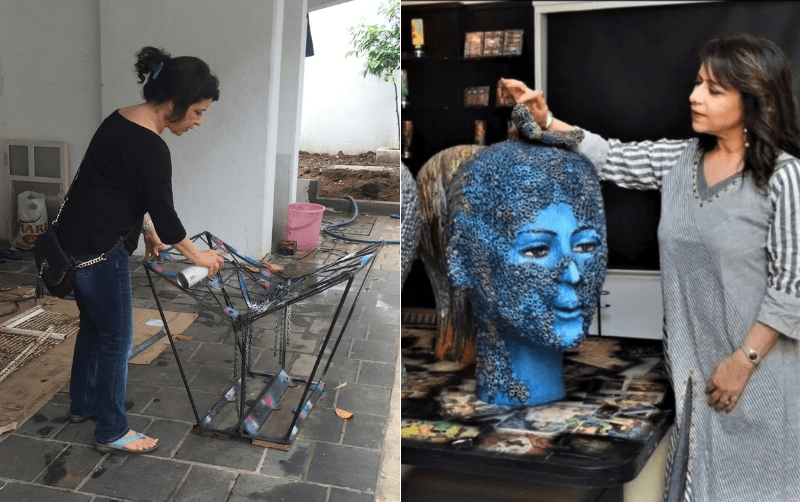
Her studio became her sanctuary and not simply a workplace. It was where she withdrew, reflected, dreamt, meditated, experimented and created. It was also where she brought people together, held workshops and conversations, and lived surrounded by the different mediums through which she expressed herself. Every artist needs such a private universe: a place with no expectations about what the next painting should look like, no market strategy, no critics, and definitely no audience. Just the artist and her understanding of herself. As I visited her studio, I realised these transformations. Madhuri’s present body of work includes series such as Horizons, Reflections, Seascapes, Moon and Florals, predominantly in oils. And while the subjects sound familiar, the treatment is unmistakably hers, sometimes recognisable, sometimes almost dissolving into colour, space and emotion.
THE BUSINESS OF ART
An important and fascinating layer to Madhuri was that she had had the good fortune to study Finance and the Art Market at London’s Sotheby’s Institute of Art. For an artist, understanding the mechanics of the art market can provide a very different perspective on the relationship between creativity and commerce. That made her astute in the ways of creating art, understanding the business surrounding it, and adding an unusual dimension to her side. The world of art, as we know it, has two very different conversations going on. One is about creativity, emotion, beauty and expression, and the other is about collectors, galleries, provenance, valuation and price. With her kind of exposure, she has lived on both sides of that conversation. She has ensured her works entered private collections and have been exhibited extensively in India and abroad. Her paintings have entered private collections and have been offered through platforms such as Saffron art. One of her works offered in a Saffronart auction (2019) sold for ₹29,040, including the buyer’s premium. This perspective is especially relevant today, when art is increasingly viewed not only as cultural expression but also as an asset class.
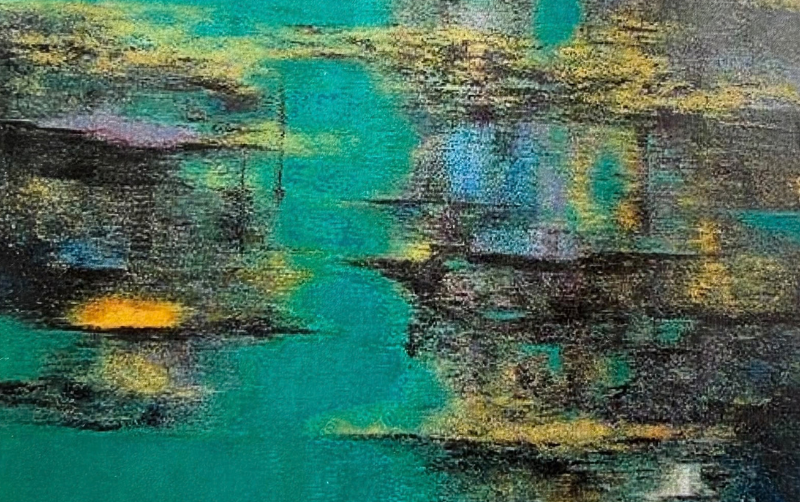
Yet an important distinction remains between a painting’s price and its value. A work’s commercial success can be measured in numbers, but its artistic significance is much harder to quantify. For an artist who has spent decades evolving rather than following a formula, that distinction becomes particularly meaningful. But what is the viability? She replied, ‘One of the things I feel that one should hold onto one’s price is that it is very important. I started with 500 rupees a square foot when I started. Now I sell at a lakh of rupees a square foot.’ Success measured with money is very relative.
Her career includes dozens of solo exhibitions and more than a hundred group shows, with her work travelling beyond India to international audiences. Her work has been shown at venues including Jehangir Art Gallery and Bal Gandharva, as well as in exhibitions in London, Dubai, Singapore, New York and elsewhere. She has also received recognition for her contribution to art, including the Women’s Economic Forum honour for Iconic Leadership in Art, Design & Entrepreneurship. But awards and exhibitions, important as they are, don’t quite explain Madhuri. Her story has always been about evolution.
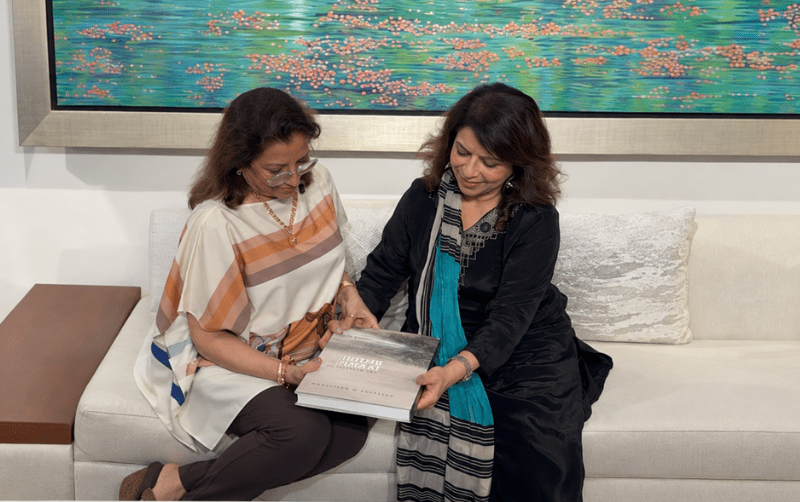
As a woman who never stood still, Madhuri Bhaduri has been painting for close to five decades. Yet there is no sense, at least from the arc of her career, that she has reached some final destination. Maybe that is because she doesn’t seem to think of art as a destination at all. And that, ultimately, may be what makes Madhuri Bhaduri’s journey worth talking about: not simply that she became a successful artist, but that she has kept reinventing the woman behind the artist. And maybe the most interesting canvas she has created is not hanging on a wall at all. It is the life she has painted for herself.
