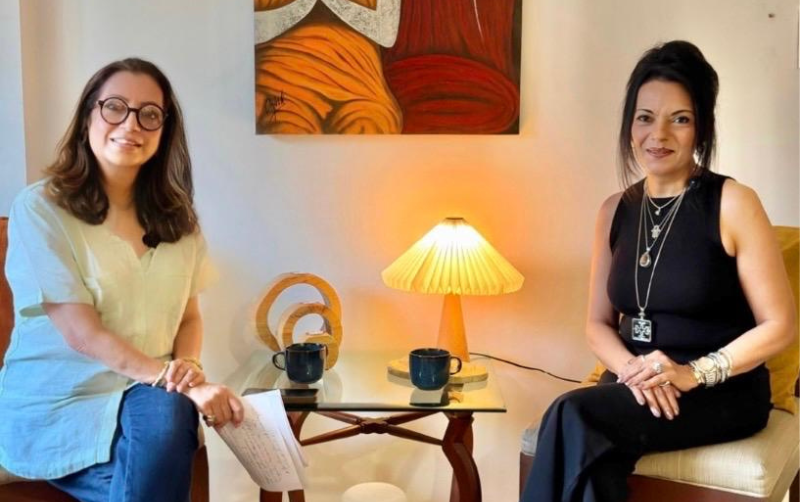


This is what happened to Onjali Prasada when she dabbled in design, became a stylist, aesthete and traveller; finally, she became a contemporary artist. Meeting her became an interesting journey into her life, where I found she hadn’t followed the conventional trajectory of an artist. Hers has been a rather more circuitous, and therefore, perhaps, richer journey of sorts. Having studied at Shantiniketan (Rabindranath Tagore’s great experiment in education and the arts), and subsequently at the National Institute of Design in Ahmedabad (two very different institutions), I learnt that both were deeply invested in the same idea that creativity is not something you simply learn- it is a way of looking at the world. And Onjali has certainly looked at the world. She has worked in luxury retail, interiors and styling. Her creative life has taken her into furniture, fashion, jewellery, food, cosmetics and spaces. She has lived in Europe and moved between different cultural landscapes. Her Indian roots and extensive European residence shaped her approach, exploring intangible emotions through dreamlike abstraction.
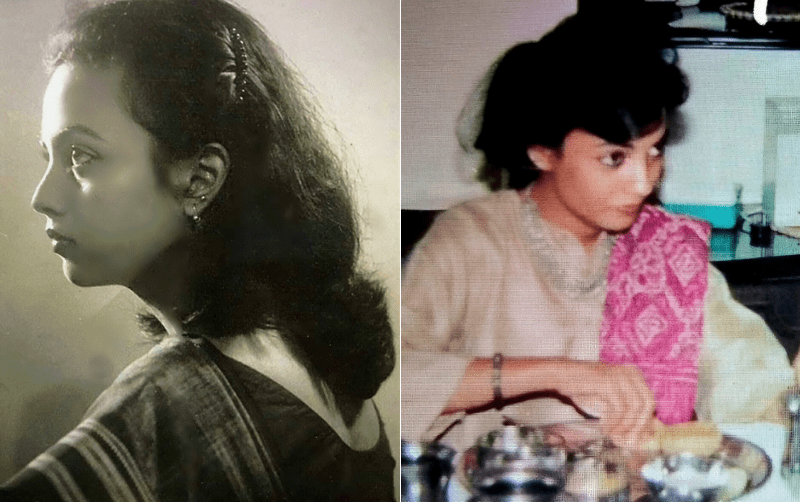
So when she paints, she isn’t approaching a canvas with only the vocabulary of a painter. She brings the eye of a designer. She understands composition and proportion. She understands how colour changes a mood and how a single detail can transform an entire visual experience. In a way, her painting has allowed Onjali to move beyond design. She understood that design ultimately has to serve a purpose to make a room work. A piece of furniture must function, just as a beautifully styled object must communicate something. But her art/ painting did not have to do any of that. All she needed was to feel, and her work has always been very much about feeling.
Her canvases have moved easily between figurative painting and abstraction, between recognisable faces and forms that seem to dissolve into patterns, motifs and gestures. Many of them feel dreamlike, as though the image is emerging from memory rather than being copied from reality. The human face, and particularly the female face, appears repeatedly. But these aren’t conventional portraits. One doesn’t look at the women and think, “Who is she?” But instead think-what could’ve happened to her?
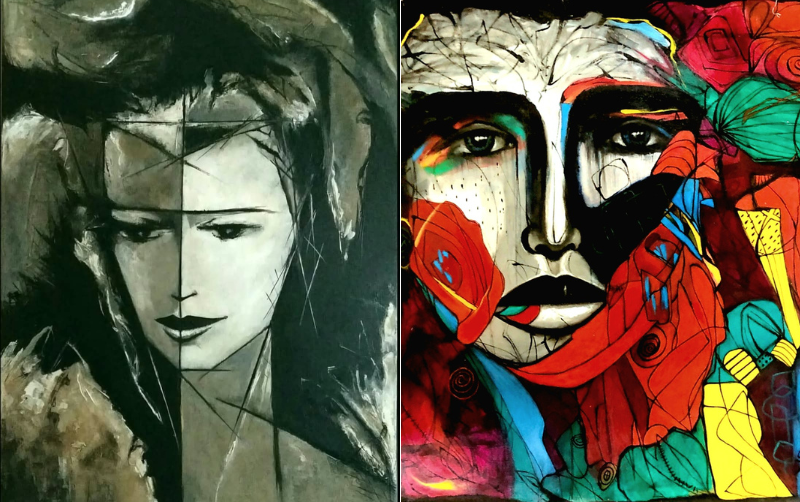
A curious tension often lives in those faces: strength beside vulnerability, joy alongside melancholy, sensuality alongside introspection. For instance, in a 2024 exhibition in Pune, Contemporary Wind brought together 19 artists and included Onjali’s work. Her women were described as holding apparently contradictory emotions-sorrow and wild joy. She has always somehow adopted contradiction, and that is perhaps the point. Because as people are contradictory so are feelings like happiness and sorrow all in the same afternoon. Strong and frightened at the same time, certain on the outside and completely unsure within. Her art/ painting embodies the same complexities.
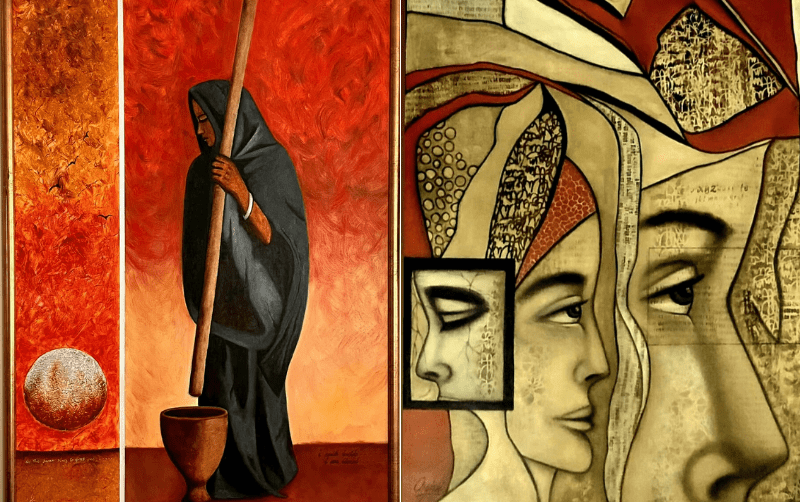
Onjali’s own thinking about art is revealing. She believes, “Art is sustenance, a way to heal ourselves and others by sharing our stories. For art to live & thrive, it must spark conversation, be observed, appreciated, and critiqued! “.Most times, we feel that art has to be explained to us, expecting the artist to give us an explanation and his/her view. But the best contemporary art, to my mind, leaves you with something that cannot quite be explained. Thankfully, Onjali’s work often does that. Her patterns and decorative elements don’t merely make the paintings pretty; they create layers that come from her design education. A life lived between disciplines, perhaps.
What is interesting is that she has lived all these different lives and used them to shape the person/artist she has become, understanding that the luxury world taught her about interiors, about space, styling, and visual storytelling, and Shantiniketan about the philosophy of her art. NID had given her discipline. And living in Europe gave her another cultural lens. Her painting became the place where all these experiences could coexist. Definitely, Onjali is a complex creative personality, who doesn’t seem particularly interested in staying inside one stylistic box. She moves between abstraction, figurative imagery and iconography.
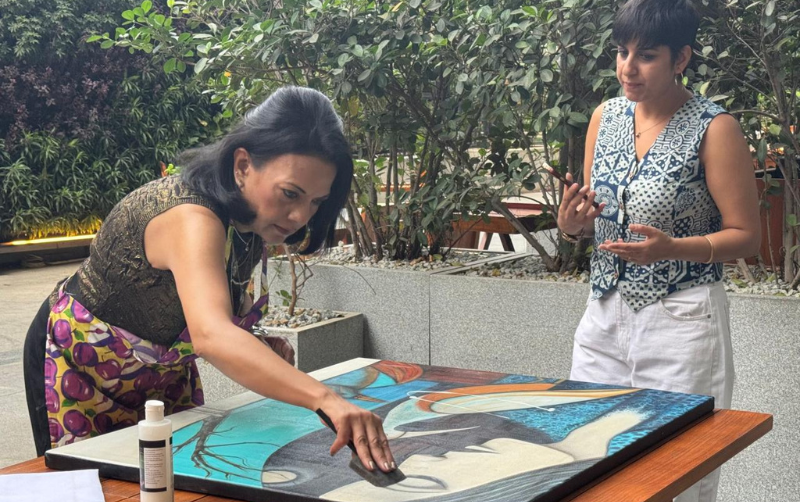
The art market, of course, prefers certainty. But Onjali’s art isn’t easy to package. Perhaps that is precisely what makes following her work interesting. Her work is already finding its way into galleries and private collections internationally. Though numbers, collections and exhibitions are all one part of an artist’s story, the real story is what compels someone to keep returning to the canvas. With Onjali, it is curiosity about people, emotion, memory, tackling what lies beneath the surface of the beautiful. I feel that’s where Art usually leaves us, furnishing us with no answers, but with just a feeling that one cannot shake.
Onjali Prasada is not a designer who became an artist, but a woman who has collected different creative lives along the way and is now putting them all onto canvas. Currently, over 200 of Onjali’s artworks grace galleries and private collections worldwide.