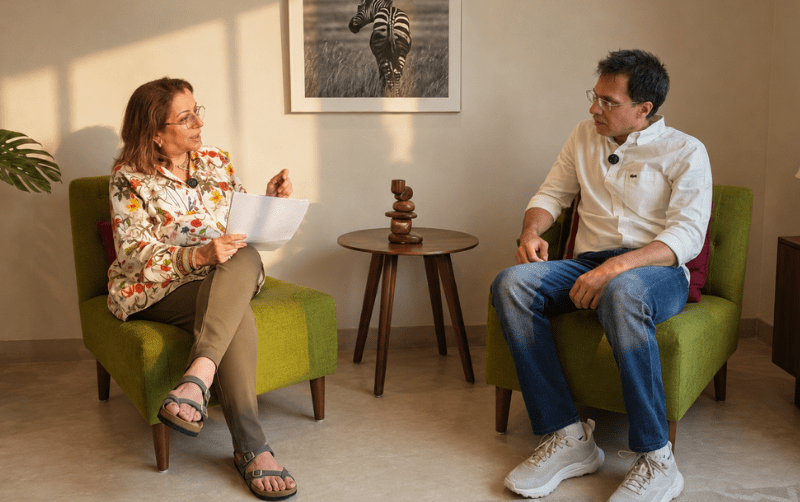

There are some people you meet and, after talking to them, you begin to look at ordinary things rather differently. Anand Damani is one of those people. He calls himself a behavioural scientist. I would describe him as someone who has become deeply curious about why we do the things we do, why we buy what we buy, why we follow the crowd, why employees behave differently depending on the environment they work in, why investors panic when their favourite stock falls, and why, despite knowing better, we so often do the opposite of what is sensible.
What I found particularly interesting about Anand is that he doesn’t approach behaviour as some dry academic subject. He seems to see the differences everywhere. And perhaps that comes from where he started. Before becoming a behavioural scientist, he spent many years in advertising, sales and marketing, working with some of the world’s biggest brands- such as Unilever, P&G, Cadbury, Asian Paints, Samsonite and L’Oréal. Eventually, he realised that understanding what people think is only half the story. The much more interesting question is: what actually makes people act the way they do? That question eventually became his profession.

In 2013, Anand founded Briefcase, a behavioural design consultancy that works with companies on everything from customer acquisition and retention to employee performance and organisational behaviour. And he has an unusually simple way of explaining what he does. “Business is so much more than putting money into something,” he tells me. “Business is about processes and systems. Behavioural science is about designing those systems in a way to get the output.” It sounds simple, doesn’t it? But then he starts to give me examples.
One of his favourite subjects is the workplace. We all talk endlessly about employee motivation, but Anand believes companies often get the basics wrong. We assume people are motivated principally by money. He tells me about an employee in one of his client’s factories who had come up with an intervention that saved the company several crores in power costs every year. And what did the company do? They gave him dinner vouchers worth ₹5,000. Anand is almost offended by how inadequate the response was. His solution would have been very different. He would have taken the employee, celebrated him, made him a star, told the organisation what he had done, turned him into a case study. Because perhaps what people want isn’t always more money. Sometimes they want recognition and autonomy, and most times they want to feel that what they do matters. And this is where Anand’s thinking becomes rather fascinating. If you want people to behave differently, he says, don’t keep telling them to change. Change the system around them.
Want more collaboration in an office? Look at how people sit. Want more innovation? Don’t punish people for thoughtful failure. Want employees to take risks? Then reward the process, not just the outcome. To us, it sounds like common sense. But, as Anand points out, organisations are often designed in precisely the opposite way. His understanding of behaviour isn’t confined to the workplace.
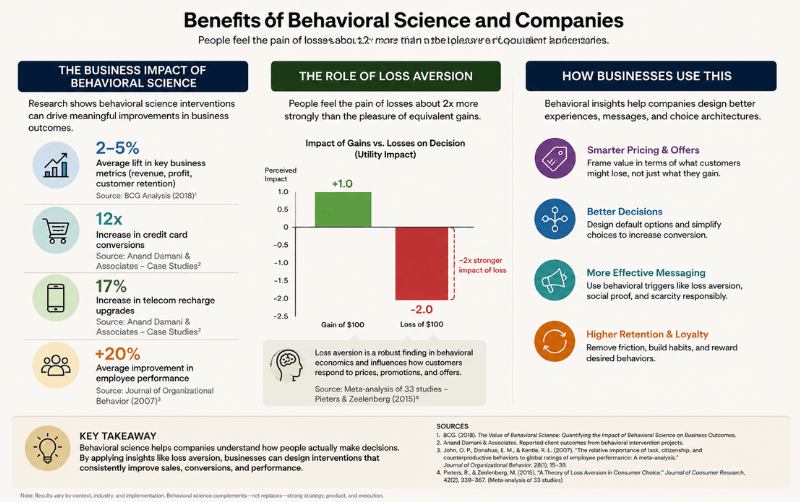
It extends to something as personal as investing. As an investor himself, Anand offers a wonderful analogy. When our favourite brands go on sale, like Nike, Lacoste, whatever we happen to covet, we get excited. We think we have found a bargain. On the other hand, when our favourite stock falls in price, we panic. The reason being, though the object hasn’t changed. The price has. We are delighted to buy something we like when it is cheaper, but frightened to buy a business we like when its share price falls. That, he says, is loss aversion. And then there is our tendency to look sideways. If everybody around us is buying something, we assume they know something we don’t. This is social proof- one of the many little psychological shortcuts that govern our lives without our even realising it.

This immediately brought to mind something as mundane as a restaurant queue. If there are ten restaurants on a street and one has a long line outside, which one are we instinctively drawn towards? Of course -the crowded one. We think surely all those people can’t be wrong. But, says Anand, that same instinct can be disastrous in the stock market. By the time everybody is buying the same stock, the bargain may already be gone. This is what makes behavioural science so interesting. It isn’t really about other people. It is about us, our little irrationalities, our habits, our prejudices, our fears and our inherent need to belong.
And perhaps Anand became interested in this because advertising had already taught him one important lesson: people don’t necessarily behave the way you expect. He tells me about his work with brands and makes a distinction I find particularly compelling. Advertising, he says, creates awareness and intention. Behavioural science is about getting someone to actually do something. His work has ranged from consumer behaviour to public behaviour, and he has also experimented with physical products designed to change habits. One example was Bleep, a device intended to reduce unnecessary honking. His work has attracted international media attention, and he has also spoken extensively at TEDx about behavioural science.
But what I like about Anand is that he doesn’t seem obsessed with making behaviour complicated. Quite the contrary. Some of the most effective behavioural changes, he says, can be almost invisible. A smart bottle developed by Briefcase, for example, used a light-and-sound reminder to encourage people to drink more water. In an experiment with office employees, the intervention increased water consumption by 16 per cent. It was a tiny intervention. You don’t necessarily have to persuade someone to become a different person. Sometimes you simply have to make the desired behaviour easier.
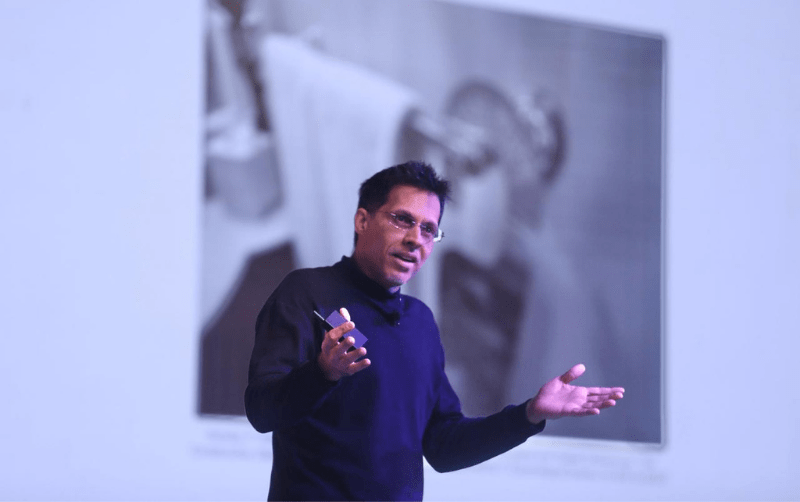
I could not conclude without asking Anand about AI and how we could make our lives easier by aligning with it, instead of fearing the system. Also, because every business today seems to be talking about artificial intelligence. Is understanding human behaviour becoming less important because machines are becoming smarter? His answer was emphatic. AI, he believes, will eventually become like the internet, something so embedded in our lives that we will stop talking about it. But understanding people will never become obsolete. Because no matter how intelligent machines become, customers, employees, investors, leaders, citizens, and human beings will still make the important decisions.
But human beings are emotional; we contradict ourselves, changing our minds ever so often. We follow others and then insist we made our own decision. We know what we should do and frequently do something else. And hence what Anand does is try to understand the strange, wonderful machinery behind our choices, and then he uses that understanding to make businesses and workplaces and perhaps even society work a little better.
As I leave our conversation, I find myself noticing things I hadn’t noticed before. The queue outside a restaurant. The way choices are presented to me on my phone. The incentives people are given at work. The way I react when a stock falls. The little decisions I make every day without ever stopping to ask myself why. Perhaps that is Anand Damani’s real gift. He doesn’t simply tell you about behavioural science. He makes you start watching yourself.