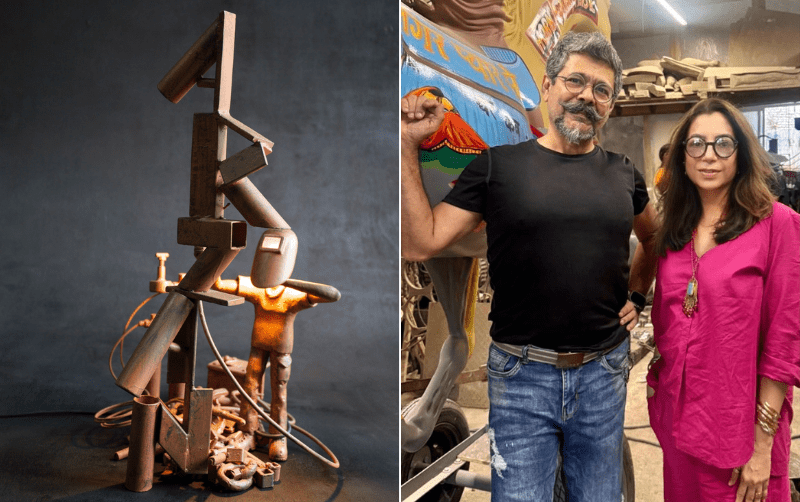

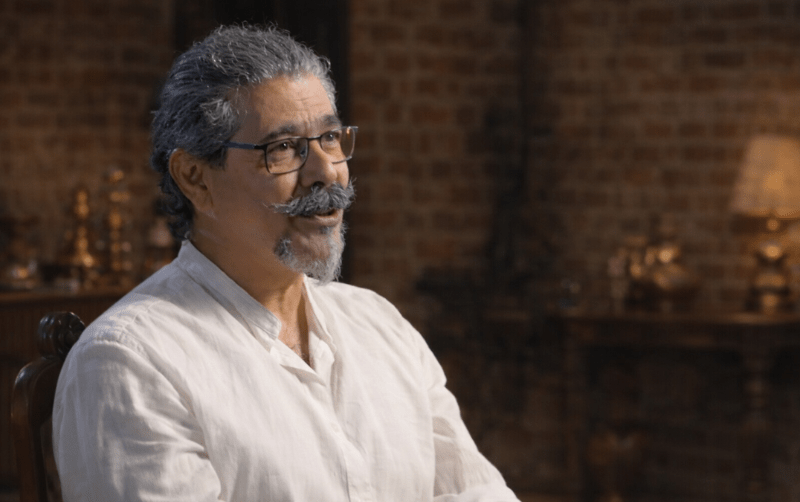
“THE IMPOSSIBLE JUST TAKES A LITTLE LONGER.”
Says the man I am in a conversation with. I have known Arzan to be a sculptor above all else. Of course, he went through the traditional route of attending the Rachna Sansad Academy of Architecture, but then transitioned to sculpting at a very young age (by choice in 1982). What most people do not know is that he started sculpting as early as class 10. Young Arzan wasn’t exactly academically bright. All his books were filled with drawings, furniture infused with humans, and caricatures of teachers. He says, ‘I was one of the outstanding students, somebody who was always thrown out of class and yet I would continue to draw even then’, twirling his trademark moustache, giving off Daliesque vibes. I understand that conformity was never his thing. Artists of calibre are exactly that.
What started off purely as a hobby slowly began to yield income when his first buyer, Architect Dara Mistry, bought his first piece(1983) for a mere Rs 2000.However, he soon gained a reputation as a visionary who challenged norms and transformed discarded metal into captivating art. People soon began to call him the Iron Man of India and Master of Metal.
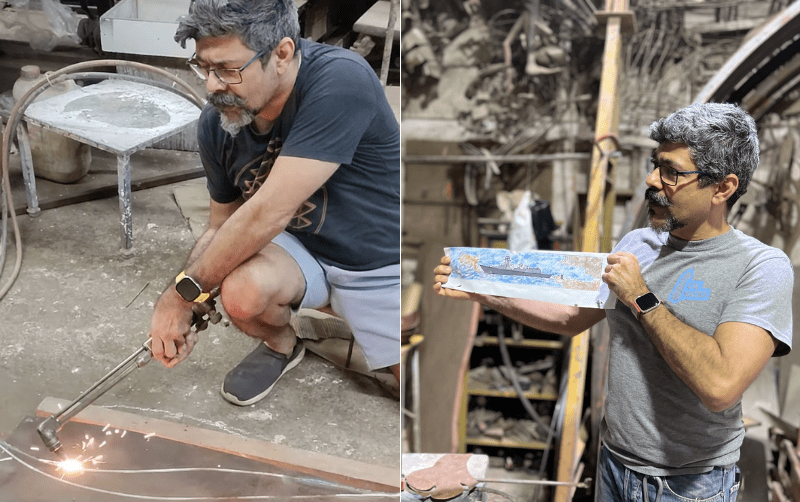
His first solo exhibition, Scraptures, ’ which opened at Jehangir Art Gallery (1983), catapulted him into the limelight. There has been no looking back since then. He had modelled all the pieces that he collected as metal scrap from wherever he could find, from by lanes and scrapyards all over Mumbai. What resulted from all that filing, bending, melding, cutting, welding, and burning was a dramatic collection; showing rivers of lava surging through charred valleys,and flaming planets spiralling dizzily through space.
Commissioned works started pouring in, the first being the MOGHUL outside the jewel of India at the Nehru Centre, commissioned by Architect Noshir Talati in 1989. The description of his work was often that he played very well with light and shadow to heighten the different moods of his work. His exhibitions and art shows made him very popular, as there were very few people actually doing his kind of work.
Today, his work is visible at many traffic junctions, as well as special commissioned projects at various corporate locales, hotels, and private collections around the world, and ranges from six inches to seventy feet in height. Does he feel that art is respected and recognized in the streets? He goes on to articulate that even- ‘though art is not appreciated that much in India and on the streets as well, the landscape has definitely changed, people are seeing it through a new lens, one can see it in the level of art works being exhibited in galleries and in the level of architectural elements one can find in everything. The definition of design is growing exponentially’.
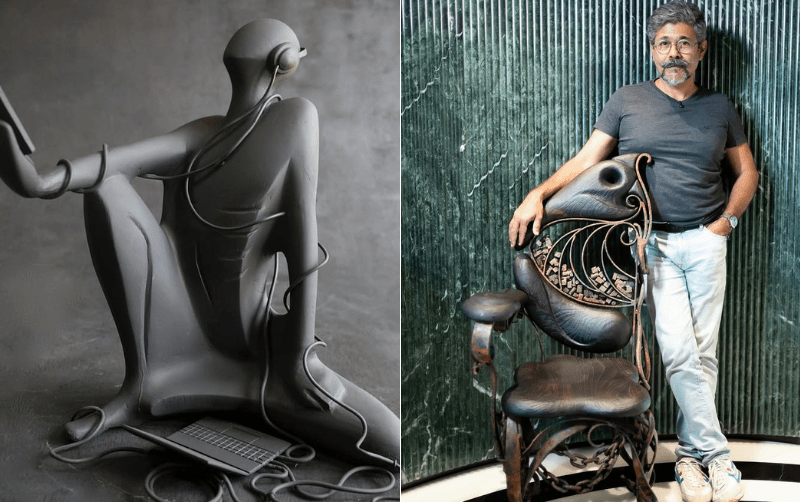
Arzan has embarked on a venture that is close to his heart, namely Photography. In fact, he had just completed his first show titled Triptych in April 2015.He also made a small film titled “Decibel“, a wacky view of noise pollution in our city. The film has had successful screenings at the Kaala Ghoda festivals. Besides sculpting and photography, Arzan dabbles in a number of activities, namely designing props and sets for experimental plays, designing and making trophies, he is an avid Iyengar yoga practitioner, loves travelling abroad, and extensively by road in India, he loves food, friends, and family, he teaches sculpture and creativity to kids at his studio, he cycles extensively, and loves solving jigsaw puzzles. A genius no doubt.
His forte today is commissioned customized works, designed and created based on the client, space, and surroundings. The first was the Moghul at the Nehru Centre in 1989, and the latest is Zebu, the 15 foot bronze bull in Worli. His works are iconic landmarks. Currently at 13 solo shows and over 100 group shows around the country and the globe, Khambatta has lately embarked on a venture that is close to his heart, namely photography and creating pen and ink art works. He is always in a state of flux, trying out new things in every direction, taking up challenges that defy his own creativity.
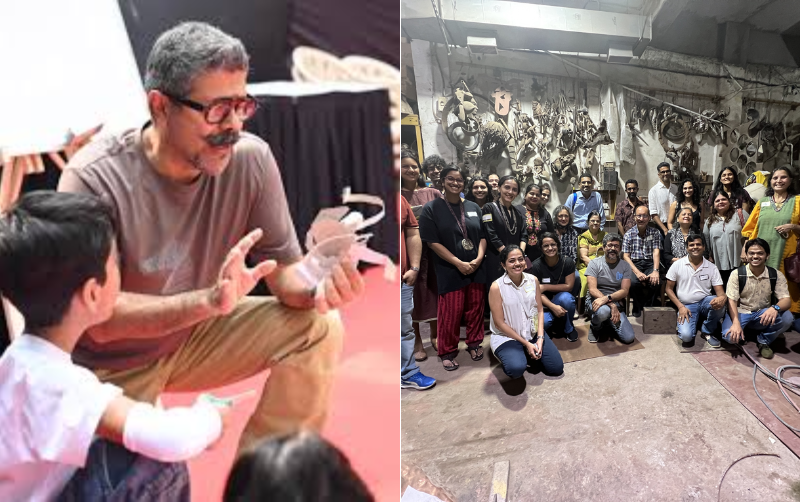
A large part of his time he spends with imparting his craft to children from all strata of society, be it the IB schools or design students, but who he is absolutely blown away by are the NGO children from Akanksha, Aseema, and Teach for India, who are all far better and more eager than any of the elite students he has taught. It could be that urban kids are so caught up with choices and gadget that their minds are not as hungry or fertile.”
As long as this city needs art, as it is devoid of contemporary Art, Arzan is here to serve. Previously, people used to dry their clothes, and birds used to poop on them. According to Arzan, ‘People should be pushed to see the Art on the streets, so that they question as they will not step into galleries to see the same. Street Art must be mature so that people can appreciate it.
What followed next was what Arzan said that made sense to me-“when we go to the movies, we sometimes don’t understand them but we get to know film stars anyway, when we go to the theatre, we get to know the artists, when we go to fashion shows, mostly we don’t really get what the designer has envisioned, same with art shows and galleries that might be too elitist for the common man so then we need open air contemporary art being displayed on the streets for the common man to question”
A man well known for his quirky sense of humor, a thinker of sorts, a planner of the impossible, is the Arzan that I know. We need more members of his tribe. Humility in an artist of his calibre is very hard to come by; he has it all. He goes to no one as his hands are full. He prefers that work comes to him naturally. He is well known for never saying no to work.